Free Solo: Climbing Without a Rope, and the Brain That Allows It
What Alex Honnold’s brain scans reveal about fear — and why the rest of us are less different from him than we think.
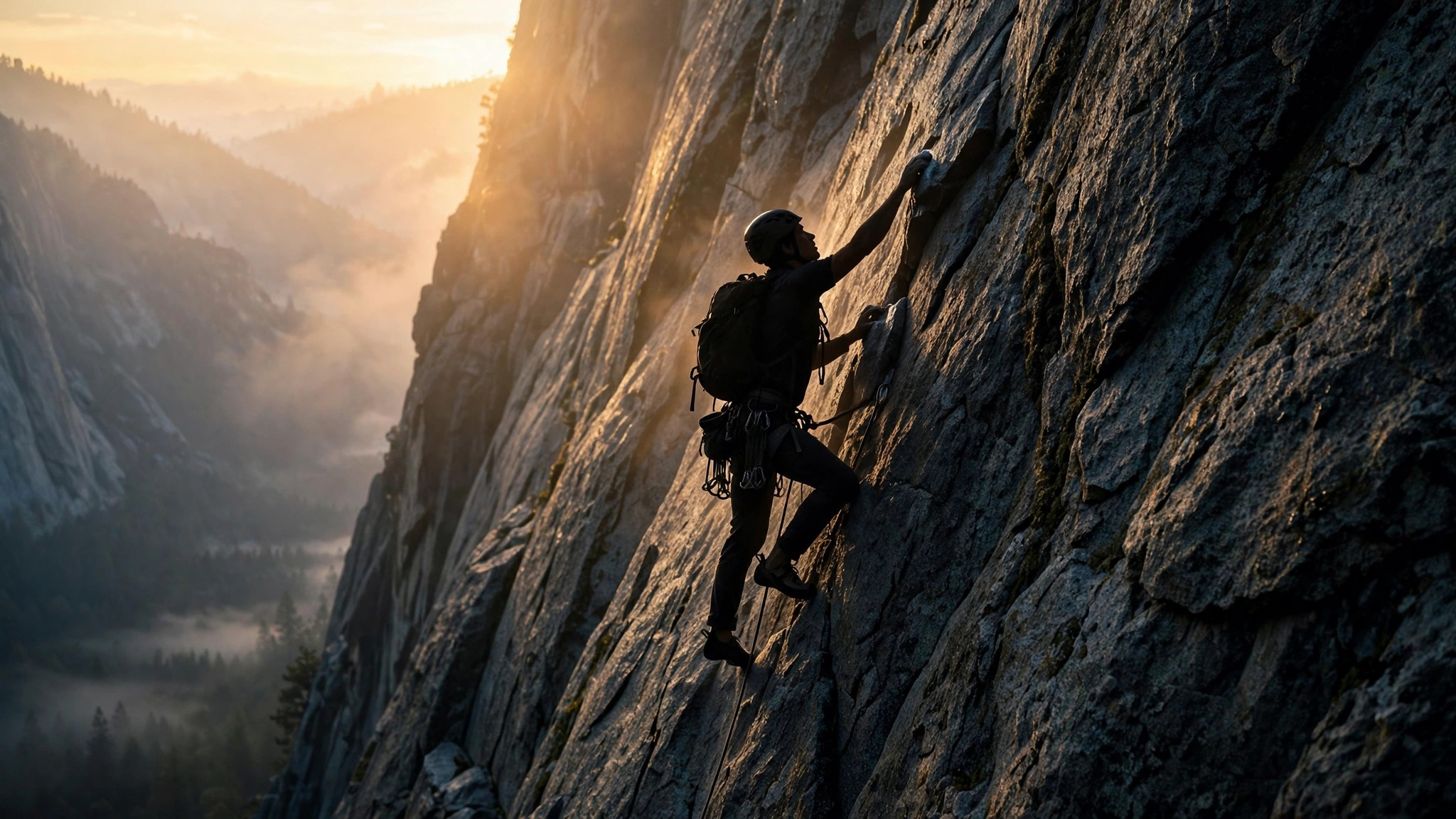
On the morning of June 3, 2017, Alex Honnold woke in his van at the base of El Capitan, ate his usual breakfast of oats, flax, chia seeds, and blueberries, and walked up to 2,900 feet of sheer granite. At about 5:32 a.m. he started climbing. He had no rope. No harness. No protection of any kind — just chalk, sticky rubber on his shoes, and a plan.
Three hours and 56 minutes later, at 9:28 a.m., he pulled himself over the summit lip and stood on a sandy ledge the size of a child’s bedroom. He had just completed the first free solo ascent of El Capitan, via the 30-pitch Freerider route, graded up to 5.13a. National Geographic called it “one of the great athletic feats of any kind, ever.”
Consider what that means. A fall anywhere in those 3,900 vertical feet of movement would have been fatal — not probable, not likely, but certain. And yet Honnold moved through the crux, the infamous Boulder Problem, with what he later described as total calm:
“At the Boulder Problem I dropped even deeper into autopilot mode — I climbed it exactly as I always had in rehearsal but without the rope this time. It felt perfect.”
Perfect. Three thousand feet up, no rope, and it felt perfect. The question isn’t just how he trained for it. The question is: what is going on inside a brain that can do this?
Sixty years of “impossible”
To understand the scale of June 3, 2017, it helps to know El Capitan’s history. When Warren Harding, Wayne Merry, and George Whitmore first climbed it in 1958, it took 11 days of siege tactics — ropes fixed up the wall for over a year beforehand. In 1975, climbers did it in a day. In 1993, Lynn Hill freed the Nose without aid. In 2015, Tommy Caldwell and Kevin Jorgeson freed the Dawn Wall after seven years of effort.
Every generation redrew the line of possible. But nobody had ever climbed the whole thing — any main face — without a rope. Free soloing 2,900 feet of technical climbing was considered, even by the world’s best climbers, the kind of thing you simply didn’t survive. It was climbing’s holy grail precisely because it seemed off-limits.
Honnold spent more than a year preparing. He climbed Freerider on rope again and again, memorizing every hold, every body position, every sequence — rehearsing until the moves lived in his muscle memory. Nothing about the day was improvised. As with every one of Ted Epstein Jr.’s crossings — Siberia on foot, the Deca-Ten, the Grand Slam of triathlons — the impossible-looking thing was, underneath, a method.
The scan
But method alone doesn’t explain a brain that stays quiet three thousand feet above the ground. So in March 2016, a year before El Capitan, cognitive neuroscientist Dr. Jane Joseph of the Medical University of South Carolina slid Honnold into an fMRI scanner to find out what his brain was made of.
Joseph was among the first researchers to study the brains of high sensation seekers. She showed Honnold around 200 images designed to provoke fear, disgust, and emotional arousal — mutilated bodies, filthy toilets, high-arousal extreme imagery. For comparison, she scanned a control subject: another male climber of similar age, also a high sensation seeker.
The control subject’s amygdala — the almond-shaped structure deep in the brain that acts as the body’s fear detector — lit up vividly, glowing electric purple on the scans. Honnold’s showed no activation at all. When the experiment flipped to a reward task where most brains “look like a Christmas tree lit up,” Honnold’s remained nearly dark, active only in the regions that process visual input — proof he was awake and watching.
After about 45 minutes in the tube, Honnold emerged and said: “What? Was that supposed to do something for me?”
For most people, Joseph noted, the image series isn’t traumatic but it is unpleasant. Honnold simply didn’t seem affected. And of the reward task, he told her: “There’s just not much going on in my brain. It just doesn’t do anything.”
Questionnaires revealed something else: Honnold scored twice as high on sensation seeking as the average person — and twenty percent higher than the average high sensation seeker. But he also scored very high on conscientiousness, the trait Joseph notes “has shown to protect against becoming addicted and getting into that spiral.” He wasn’t a reckless thrill-chaser. He was something rarer: a calculated risk-taker whose brain didn’t ambush him with panic.
Born fearless, or trained?
Here is where it gets interesting. Joseph offered two theories, and both matter.
The first: maybe his amygdala simply doesn’t fire to these stimuli. A wiring difference. Born different. “There are probably some stimuli that would activate his amygdala,” Joseph said, “but if you just compare him to the norm or baseline, he does not show anything.”
The second: maybe his regulatory system is so well-trained that it neutralizes fear before the scan can see it. His frontal cortex — the brain’s rational brake — may be powerful enough to calm the alarm before it ever fires. In this theory, years of working through terrifying situations recalibrated what his brain treats as a threat.
And Honnold himself insists he does feel fear. “Through imagination and practice,” the research summaries note, “he has desensitized himself to most fearful situations.” His own framing is closer to what any endurance athlete knows: you don’t get a fearless brain. You build one, one exposure at a time. He visualized the moves on El Capitan thousands of times. He fell, on rope, in rehearsal, in the same spots. Each rehearsal told his nervous system: this hold, this sequence, is safe.
The truth is probably both theories at once — an unusually quiet alarm, plus years of deliberately training it. Nature handed him a head start; he built the rest.
What this has to do with you
Most of us will never free solo a wall. We don’t need to. But the machinery Honnold uses is the same machinery every one of us carries — including into the non-climbing terrors of ordinary life: the surgery, the diagnosis, the business bet, the first 5K when your knees are gone.
Three things transfer:
1. Fear is data, not an order. The amygdala fires an alarm; it doesn’t make the decision. Honnold’s gift — natural, trained, or both — is that the alarm doesn’t drown out the thinking. You can practice this too, on a smaller stage: the cold shower, the hard conversation, the pitch you’ve rehearsed until the words are automatic. Exposure teaches your nervous system what is actually dangerous versus merely uncomfortable.
2. Preparation converts terror into procedure. Honnold didn’t fight fear on the wall; he eliminated the uncertainty that causes it. He climbed Freerider exactly as he’d rehearsed. Ted did the same crossing Siberia: break the distance into one decision — take the next step, then the next. Anxiety lives in the unknown. Rehearsal shrinks the unknown.
3. Conscientiousness is the seatbelt. The most overlooked finding in Joseph’s work is that Honnold’s conscientiousness protected him. The daredevil myth says fearlessness equals recklessness. The science says the opposite: the people who survive impossible things are the meticulous ones. They plan, they train, they rehearse, they check the weather, they bail when it’s wrong.
Earlier this year, Honnold free-soloed Taipei 101 — a 101-story skyscraper, live on Netflix — and climbed down grinning in high wind. Nearly a decade after El Capitan, the machine still works. And the film that documented his El Capitan climb, Free Solo by Jimmy Chin and Elizabeth Chai Vasarhelyi, won the Academy Award for Best Documentary Feature — proof that the world recognized what it had witnessed.
But the deeper lesson isn’t in the film’s sweeping shots of granite. It’s in the scanner. Limits, it turns out, are partly hardware and partly training. You may not be born with Honnold’s hardware. But the training part? That’s available to anyone willing to take the next step.
The Lesson
You don’t eliminate fear. You train it — with preparation, with repetition, and with the discipline to never confuse courage with carelessness.
“Limits are just doors.”
Leave a Reply