The Leadville 100 — A Test of Grit and Character (1988)
Five years after his first attempt at the legendary Leadville 100, Ted was ready to take on the brutal 100-mile mountain race once again. This time, he wasn’t alone. A close friend had decided to try Leadville for the first time and asked Ted to join him.
Training was intense — and unusual. Many of their practice runs began at 2:00 A.M. on Lookout Mountain west of Denver. They experimented with different lights and gear, trying to prepare for what it feels like to run through total darkness. Without moonlight, the trail disappears into pitch black. For most runners that’s hard. For Ted, whose night vision was poor, it was even harder.
They had their plans set. Entry fees paid. Motel rooms booked. Volunteer friends ready to pace them.
Then, four weeks before the race, Ted received an invitation that stopped him in his tracks.
Only 25 cyclists in the entire United States had been invited to participate in the PAC Bike Tour Across America — a rare, prestigious event. Ted was honored and thrilled. Opportunities like this don’t come twice.
But there was a problem.
The bike tour and the Leadville 100 were scheduled at the same time.
Ted had given his word to his friend. The friend was furious when Ted explained the situation. To him, there was no dilemma at all — a promise had been made.
Ted faced a true moral crossroads.
A Man of His Word
Ted wrestled with the decision. He even proposed a wild plan: start the bike tour in California, fly back to Colorado to run Leadville, then fly back to rejoin the cyclists. His friend argued that Ted would arrive at Leadville exhausted and ruin his race.
After deep soul-searching — and with understanding from the PAC Tour directors — Ted made his choice.
He would honor his commitment.
He would run Leadville.
The bike tour would have to wait.
True to his nature, Ted chose loyalty over personal glory.
The Mountain Doesn’t Care
Leadville always finds new ways to test runners.
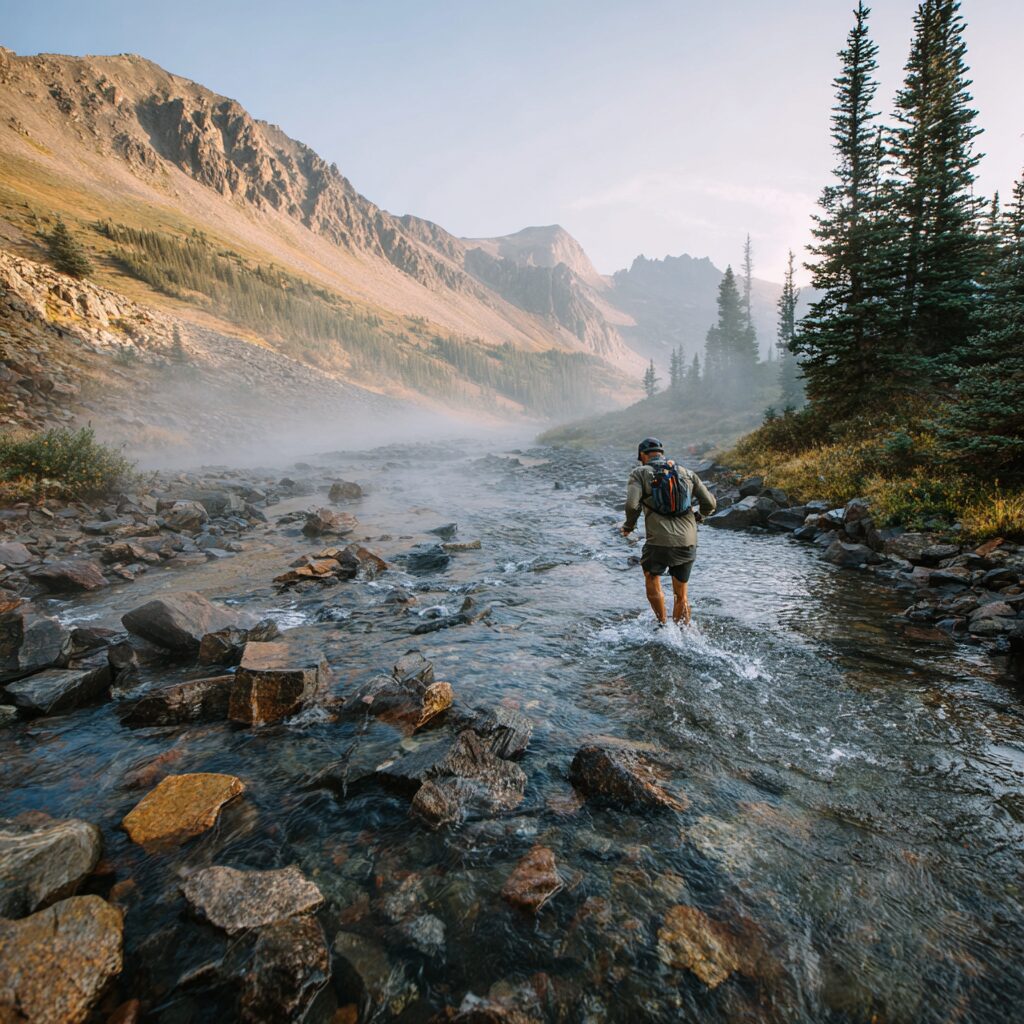
At one point, Ted came upon a 25-yard stretch of knee-deep, ice-cold water flowing across the trail. The Army Corps of Engineers had planned to build a bridge — but hadn’t yet.
Most runners removed their shoes and waded through. The rocks below were sharp, slicing at their feet.
Ted tried a different tactic. He pulled off his socks and slipped plastic bags over his shoes to keep them dry. It was clever — in theory.
But the jagged rocks shredded the plastic. Water poured into his shoes anyway. Worse still, he forgot to remove his inner soles, which became completely soaked. For the next three hours, Ted ran in waterlogged shoes, feeling new blisters form with every step.
But stopping wasn’t an option.
In Leadville, you keep moving — or you don’t finish.
The Spirit of Leadville
Runners from around the world spend entire summers in Leadville preparing for the high altitude and punishing terrain.
There was Marge Adelman, one of the strongest women in the race, who trained every weekend climbing in the mountains. Severe stomach cramps forced her to drop out.
And then there was newcomer Steve Spade, who boldly predicted he would finish in 18 hours — an almost unbelievable claim. Amazingly, he did.
Leadville humbles some and elevates others. But it tests everyone.
More Than a Race
For Ted, Leadville wasn’t just about miles. It was about commitment, integrity, and perseverance.
He chose friendship over fame. He endured pain without complaint. He adapted, improvised, and pushed forward when conditions turned miserable.
Because that’s who Ted was.
Not just an endurance athlete —
but a man who believed that your word matters as much as your willpower.
Mountains, Miles, and Relentless Momentum
Even when Ted did everything “right,” endurance had a way of demanding more.
During the Leadville 100, despite drinking a quart of water every ten miles — plus more at aid stations — Ted still lost seven pounds. Dehydrated and drained, he pushed on anyway, crossing three massive mountains, including Colorado’s highest peak, Mt. Elbert, climbing from 10,500 to 13,000 feet.
It was brutal. But it was also a personal victory. He finished.
When he finally returned home, the cost became clear. His toes throbbed. His muscles screamed. After being awake and moving for 30 straight hours, he could barely walk from his bed to the next room.
And yet, the next morning, Ted boarded a plane.
He wasn’t going home to rest. He was going to start another race.
PAC Bike Tour — August 1988
From Running on Blisters to Riding Through Fire
Ted stepped off the plane in Dallas already battered — feet covered in blisters, legs aching, body exhausted. Then he climbed onto a bike and began adding saddle sores and burning quadriceps to the list.
Most of the cyclists had trained at staggering levels — 500 to 1,000 miles a week. Ted? He had been riding about 100 miles a week. He was, by far, the least prepared rider in the group.
To keep up with the required 167 miles per day, Ted gave up lunch breaks and snack stops. He just kept pedaling. A banana handed out of the support van felt like a luxury. The one hot meal of the week felt like a feast.
For ten straight days, temperatures soared to 95 degrees. Fatigue blurred his thoughts. More than once, Ted wondered why he was doing this at all. He wished he were anywhere else.
But he stayed alert — he had to. High-speed traffic rushed past, and a moment of inattention could mean disaster.
His poor eyesight made things even harder. His eye doctor had cleverly fitted one contact lens for distance vision and the other for reading. Unfortunately, on a bike, the rear-view mirror sits on the left — the very side where Ted’s eye was set for close vision. He literally couldn’t see what was coming up behind him.
Still, mile after mile, he rode on.
And he finished.
PAC Bike Race — August 1989
Coming Back Stronger
The following year, Ted returned — this time to complete the entire PAC Bike Race.
He rode 2,700 miles across the United States.
Not because it was easy.
Not because it made sense.
But because somewhere inside him, the challenge itself was the reward.
Grand Canyon — Summer 1990
One of the Toughest Runs on Earth
Ted and his friend Michael Smith took on one of the most demanding endurance feats imaginable: running from the South Rim of the Grand Canyon to the North Rim and back — all in a single day.
They did it once.
Then, as if that weren’t enough, they did it again years later.
For nearly a decade, the two men also shared a simpler ritual — running 15 miles together every morning in Denver. No race numbers. No crowds. Just friendship, discipline, and the quiet joy of movement.
Ted never chased comfort.
He chased possibility.
And every time his body said enough, his spirit quietly answered,
“Just a little farther.”
Leave a Reply