The Birthday Ride That Broke His Bones
RAAM — Race Across America, 1994
Some people celebrate birthdays with cake.
Ted Epstein chose 3,000 miles of pain.
In 1994, at 59 years old, Ted lined up for one of the most brutal endurance events on Earth — the Race Across America, known simply as RAAM. Ultra Magazine had already labeled it the toughest endurance race in the world. Longer than the Tour de France. No stages. No rest days. Just one continuous push from the Pacific Ocean to the Atlantic.
West coast to east coast.
Sleep optional.
Sanity negotiable.
Ted would be the oldest rider in the field.
Qualifying for the Impossible
Before RAAM would even let him start, Ted had to prove he belonged. He rode the Tour of North Texas, a 500+ mile qualifier, finishing strong enough to earn his spot. Nonstop riding. Minimal sleep. Relentless pace.
It was just a preview of what was coming.
Building the Rolling Lifeline
RAAM isn’t a solo journey. It’s a moving expedition.
Ted assembled a crew of eight volunteers — cyclists, friends, believers. They found an old white van with a For Sale sign just a mile from home. It became their command center. A PA system was bolted to the roof so they could shout encouragement. The van filled with food, tools, spare parts, sleeping bags — everything needed to keep one man moving across a continent.
They would follow Ted like a shadow.
No drafting. No shortcuts. No outside help beyond the support vehicle.
Just Ted, the road, and the ticking clock.
Life at the Edge of Exhaustion
From Irvine, California, Ted began pedaling east.
Days blurred into nights. Nights dissolved into a strange twilight haze where time lost meaning. Ted slept two hours a day, usually in 15-minute fragments. Highways stretched endlessly through deserts and plains. No trees. No towns. No visual landmarks. Just wind and asphalt.
The crew watched his form change. Shoulders sagging. Head dipping. Pedal strokes growing heavy. But still — he rode.
Then came Oklahoma.
The Thing in the Dark
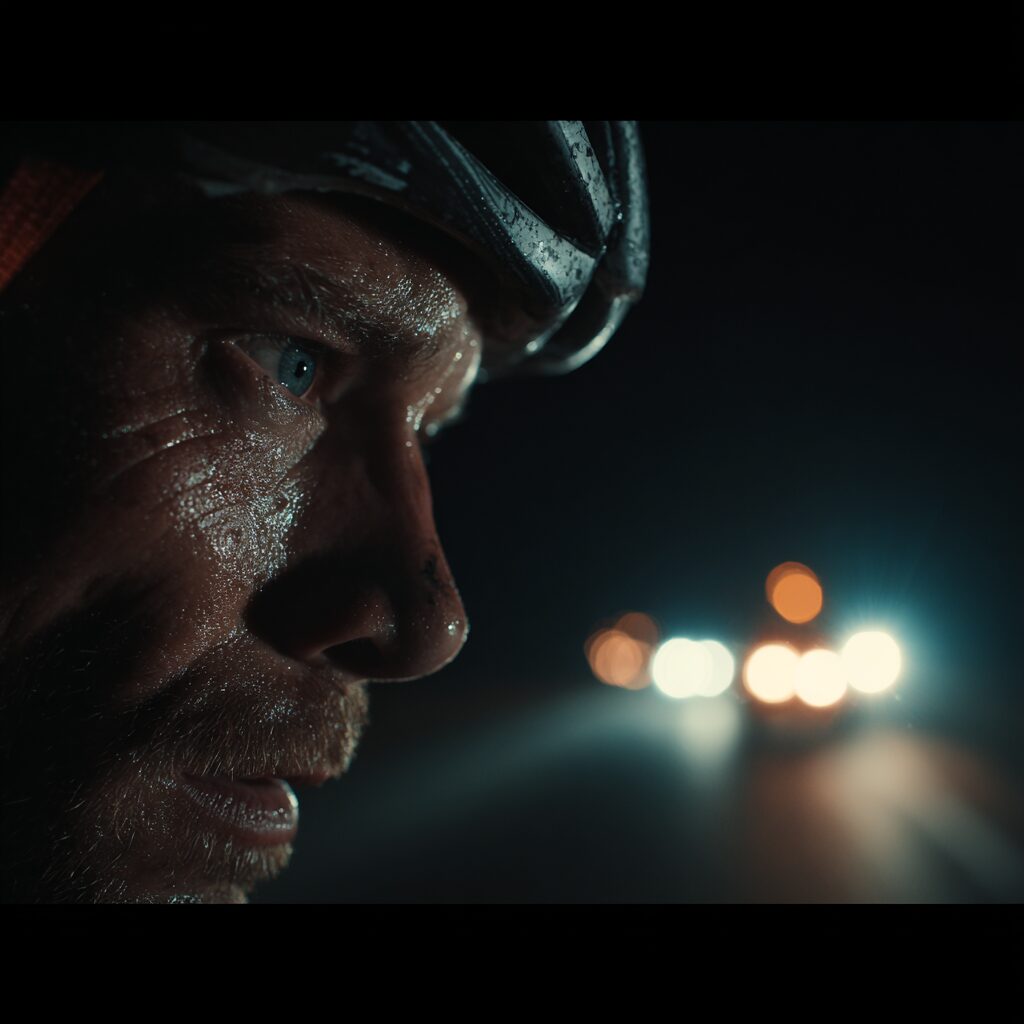
It was night. No moon. The support van trailed at a legal distance behind, its headlights too far back to light the shoulder.
Ahead, on the edge of the road, lay a shredded truck tire — invisible in the darkness.
Ted never saw it.
He struck the rubber at full speed. The impact launched him over the handlebars. He hit the ground hard and didn’t get up.
Within minutes, the crew had him in the van, racing toward the nearest small-town hospital. X-rays told the story:
Five broken ribs.
One shattered clavicle.
A concussion.
RAAM was over.
The Long Ride Home
Ted didn’t return home in victory. He returned lying flat in the back of the van on a sleeping bag, every bump in the road sending shockwaves through his ribs. At the hospital, no one thought to give him a urinal, so each stop meant pulling himself upright through agony just to step outside.
The crew, drained and emotionally spent, finally checked into motels for their first real showers in days.
The race had ended.
But endurance hadn’t.
Recovery, the Hard Way
Back in Denver, even sleep was a challenge. Lying flat made it nearly impossible for Ted to stand again. Vivian dragged a chaise lounge inside so he could rest at an angle. One night, he slipped off and crashed onto the floor, unable to catch himself. Chairs were placed around him after that to keep him from rolling out again.
Months passed. The ribs slowly healed.
The clavicle never quite did. Ted refused surgery. It healed crooked — a permanent, physical reminder of the night the road threw him down.
What RAAM Really Took — and Gave
Ted never finished RAAM.
But that’s not the whole story.
He showed up at 59 years old to face a race that humbles elite athletes half his age. He built a team. He trained. He rode through exhaustion most people never touch. And when the road finally stopped him, it did so only after days of relentless forward motion.
RAAM took his bones.
It couldn’t take his spirit.
Because for Ted, endurance was never about crossing every finish line.
It was about daring to start the ones that scared you most.
Leave a Reply